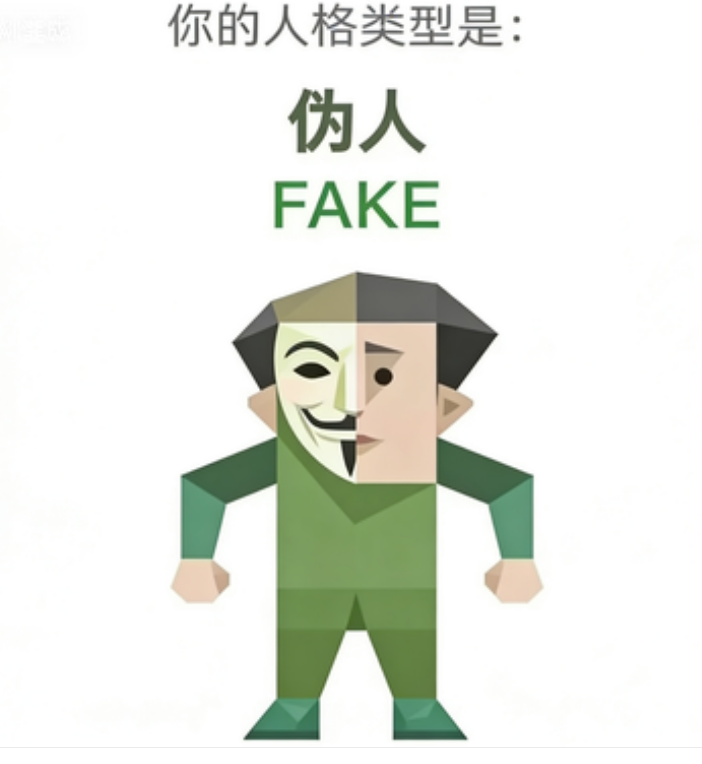
What is FAKE SBTI?
SCP Foundation Urgent Report: Item No. SCP-CN-████ "Pseudoman". In social situations, pseudo-persons are versatile beings because they can switch personas faster than they can switch input methods on their mobile phones. One second they were still in the loyal buddy mode, and the next second the leader came and they instantly switched to the calm, reliable and good employee mode, even the gloss and curl on their face were fine-tuned. Do you think you have made a friend who really understands you? Wake up. You are just lucky enough to meet an android who is good at disguise and has high performance. In the dead of night, the dummy took off the masks layer by layer, and finally discovered that there was a lot of space under the mask, and it was these masks that made up himself. This is not an indictment — it's a diagnosis. The FAKE personality didn't arrive at social fluidity through cynicism. They arrived there through survival. Somewhere along the way, they learned that showing the full, unedited version of themselves resulted in outcomes that were uncomfortable or dangerous, and so the mask wardrobe expanded. One mask became a collection. The collection became a closet. The closet became a house they live in. The remarkable thing is that FAKE types are often genuinely gifted at understanding people. Their adaptability requires it — you cannot accurately mirror someone you don't understand. The result is a personality type with exceptional social intelligence and a private crisis about whether any of it is real. They know what you want to hear. They can give it to you. But knowing that they know creates a vertigo that doesn't go away. The FAKE personality's deepest fear is being seen and rejected. The deepest irony is that the masks prevent the seeing, which prevents the real acceptance they need, which requires the masks to stay. It's an elegant trap. The way out, when FAKE types find it, is usually through one person — one relationship where the performance slowly, carefully, terrifyingly came down and nobody left. That experience changes everything.
FAKE Personality Traits & Profile
FAKE Strengths
- Socially adaptive in ways that make them effective across wildly different contexts
- Reads people with impressive accuracy — this skill is real regardless of how it's deployed
- Navigates complex social hierarchies and politics with enviable ease
- Rarely creates unnecessary conflict because they understand what each person needs
- Professionally versatile and able to present credibly in almost any environment
- Self-aware enough to know the masks exist, which is the beginning of not needing them
FAKE Weaknesses
- Deep uncertainty about which version of themselves is actually them
- Authentic intimacy feels genuinely high-risk, making vulnerability extremely difficult
- Exhaustion from continuous performance that has no obvious off switch
- Risk of losing track of actual preferences, opinions, and wants under all the adaptation
FAKE in Relationships
FAKE types in relationships are engaged in a constant low-level negotiation between the person they're performing and the person they actually are. In early romantic relationships, they are often remarkably attuned partners — they notice what you need and provide it with accuracy that feels almost telepathic. The complication comes with depth: as relationships grow closer, the masks that worked in the beginning feel increasingly dishonest, and the fear of dropping them becomes entangled with the fear of losing the relationship. Partners who find their way to the real FAKE underneath often describe a completely different person — more uncertain, more strange, more interesting, more worth knowing. In friendships, FAKE types are genuinely popular because they make everyone feel uniquely understood, and that experience is real even if the presentation is curated. At work, they are adaptable, politically intelligent, and effective in roles that require managing multiple relationships simultaneously. The relationship FAKE types need most is the one where someone stays after the mask comes off — and then tells them the person underneath was worth meeting.
How Rare Is FAKE?
FAKE personalities represent approximately 6-8% of the population, and their presence is felt far more broadly in social ecosystems because they are, by design, hard to detect. They are not rare in the sense of being unusual — the adaptive instinct is nearly universal — but rare in the sense that this level of social fluidity as a primary mode of being represents a specific configuration that takes years to develop. What makes them genuinely rare is the combination of intelligence, social sensitivity, and the particular kind of loneliness that comes from being very good at connection while remaining uncertain whether you've ever actually been connected.
Compare with Other Types
How does FAKE compare to other SBTI personality types? Here's how each related type differs at a glance.
Are you a FAKE?
Take the test to see your personalized dimension breakdown.