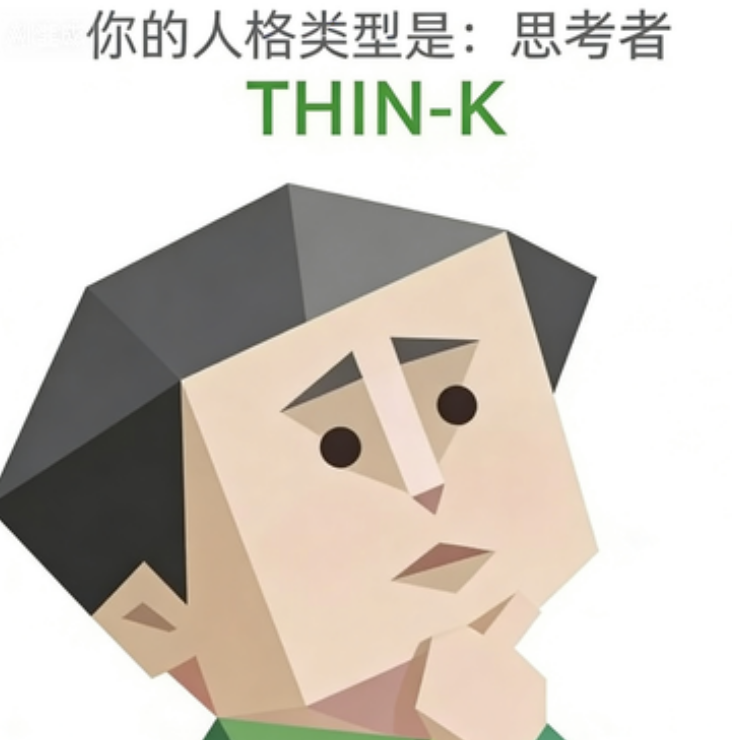
What is THIN-K SBTI?
Research has found that the brain structure of THIN-K personality is fundamentally different from that of ordinary people. As the name suggests, your brain is in a thinking state for long periods of time. You are very good at judging information, paying attention to arguments, arguments, logical reasoning, potential biases, and even a complete set of "investigation reports on the author's ideological background within three generations". In this era of information explosion, you will never follow blindly easily, you will weigh the pros and cons in a relationship, and you will also defend your own space. Are you in a daze when others see you alone? Silly, that's not being in a daze, that's your brain sorting, filing, and destroying all the information it received today. The THIN-K personality is what you get when critical thinking isn't a skill practiced occasionally in academic settings but an always-on operating system that can't be turned off, even when it would be socially convenient to do so. When someone sends a viral article to the group chat, THIN-K is already reading the methodology section. When someone makes a confident claim at dinner, THIN-K is involuntarily running source quality assessments. This is not a choice. It is literally how their brain was built. The social friction this creates is real. Nobody loves the person who notes the logical fallacy in what was meant to be a lighthearted opinion. But the value THIN-K provides in environments where accuracy matters is exceptional. They are the ones who catch the assumption buried in slide 14 that would have derailed the whole project. They are the ones who read the terms of service. They are the ones who ask "but how do we know that's true?" at exactly the moment when everyone else has already committed to the answer. THIN-K has a deep respect for the truth that borders on the inconvenient. In a world that increasingly rewards confident wrongness, this is a feature that looks like a bug until the bug causes a catastrophe that THIN-K warned about six months ago.
THIN-K Personality Traits & Profile
THIN-K Strengths
- Processes information with a level of rigor that most systems simply don't apply
- Identifies logical flaws, hidden assumptions, and weak evidence before they cause damage
- Resistant to manipulation, propaganda, and emotionally-driven bad decisions
- Produces analysis that holds up under scrutiny because it was scrutinized in production
- Defends positions based on evidence, not social pressure or sunk cost
THIN-K Weaknesses
- Critical thinking mode can activate in social contexts where it creates unnecessary friction
- Analysis paralysis: all options get evaluated so thoroughly that decisions slow to a crawl
- Can come across as contrarian, pedantic, or exhaustingly skeptical to casual observers
- Overthinking occasionally obscures simple, adequate solutions to simple problems
THIN-K in Relationships
THIN-K in relationships is a generous and somewhat demanding intellectual companion. They will genuinely engage with everything you say — not just nod and move on — which is both flattering and occasionally exhausting. Partners need to be secure enough to have their ideas pushed on without feeling attacked; THIN-K is not challenging you, they are engaging with you, and the distinction matters. In return, THIN-K offers something increasingly scarce: they actually listen, actually think, and actually tell you what they think rather than what they calculate you want to hear. Friendships with THIN-K tend to involve fewer people but unusually high quality conversations. At work, THIN-K is invaluable in any role where the cost of being wrong is high — research, strategy, quality assurance, risk — and less naturally suited to environments that reward speed and confidence over accuracy.
How Rare Is THIN-K?
THIN-K personalities account for approximately 7-9% of the population, though their impact in any given environment often exceeds their numbers. In an information ecosystem built to exploit cognitive shortcuts, having a brain that automatically applies critical friction is genuinely unusual. The world regularly produces overconfident people in large quantities. It produces careful, rigorous, epistemically humble thinkers much more rarely. THIN-K's unique value: they make every system they're part of slightly more honest, slightly more accurate, and substantially less likely to be confidently wrong at scale.
Compare with Other Types
How does THIN-K compare to other SBTI personality types? Here's how each related type differs at a glance.
Are you a THIN-K?
Take the test to see your personalized dimension breakdown.